Coffee & Contemplation: Unemployment

With everything going on in the United States right now, many people are learning about unemployment. They’re learning about it because most of them never needed it before. Some benefits have been added due to the pandemic, but there are still some things people don’t about unemployment in general. For example, it is a service one must pay into in order to receive the benefits. That means self-employed folks who don’t put money away for unemployment will not receive unemployment benefits. That’s under normal circumstances. Supposedly, things have been put in place to help self-employed folks who’ve lost work due to Covid-19.

When one applies for unemployment, the service looks at how much you paid into that service during the previous year. I applied for unemployment this year. They reviewed what I paid in 2019 to determine how much I’ll receive. A small percentage of money is taken from every paycheck. The more money one makes, the more money is put away. The employer also matches the amount from each paycheck. Someone making minimum wage will receive less than someone making an annual salary in unemployment benefits. The most I can get is $800 per month. That does not include the $600 extra that everyone is supposed to receive due to Covid-19.

Now, I understand that they give a certain amount each week so one’s unemployment can last up to six months or even a year. That makes sense. But it feels unfair that, under normal circumstances, I would get less than minimum wage to cover all my expenses for a month. I only have rent and utilities to pay if you include a phone bill in utilities. $800 is not enough to cover those couple of things as well as food for the month. And here’s my other question. What happened to all the money I paid into unemployment for the last 12 years? Isn’t that still my money? Why can’t I use that during unemployment? These are only a few things I sit and think about while I enjoy my morning coffee.
Write Prose Like the Pros: Show and Tell

There are a few ways for a writer to show more in their prose. One option is to describe a character’s action versus telling the reader about their emotions. It’s easy to see that someone is angry based on their behavior. To say they’re angry and move on is a lack of creativity. Mentioning any emotions outside of dialogue is unnecessary. The easiest way I’ve been able to show more is by adding more dialogue to my narratives. I try to have my characters tell the story instead of the narrator.

I have an advantage over other writers when it comes to writing dialogue. I studied theatre for my undergraduate degree. I’ve read many plays and scripts. I am already comfortable with the idea of telling an entire story with only dialogue. This also gives me an advantage on how authentic the dialogue sounds. Whether for playscripts or novels, dialogue must be spoken aloud when revising. Sometimes a phrase doesn’t sound genuine once it’s said aloud. Also, if a character is said to be not well educated, using legal terms or other big words would be out of character. Writing great dialogue requires practice like everything else.

For my undergraduate minor, I studied creative writing. One exercise I did for a fiction writing class was to eve’s drop on a conversation and transcribe the dialogue. The instructor suggested recording the audio then writing it later. We were to study how people spoke in a normal, casual conversation. Then we were to compare that with dialogue we had written and look for differences. The goal was to write genuine, authentic dialogue. I encourage others to try this exercise. Then they should ask themselves, “Does this sound the way people actually talk?” Deciding how a character talks is another part of character development. 

People say things differently depending on where they grew up. In the Northern United States, when referring to soft drinks, people might call it ‘pop’ or ‘soda.’ Maybe even ‘soda pop.’ In the Southern United States, most soft drinks regardless of brand are called ‘coke.’ This is not true of everyone from these regions. So, does the character say ‘trashcan’ or ‘waste basket?’ Would that person say ‘dinner’ or would they say ‘supper?’ All this doesn’t have to be figured out when writing the first draft. Many of these little things are worked out and cleaned up in editing.

The best place to learn how to improve one’s writing is with Renni Browne and Dave King’s “Self-Editing for Fiction Writers: How to Edit Yourself into Print.” If I were teaching a class on fiction writing, this is the book I would use as the course textbook.

6 Challenges for Every Poet

I have written poetry for almost 18 years. That has totaled about 500 poems. After so many poems, it becomes too easy. To stay invested in writing, to maintain interest and intrigue, you have to keep challenging yourself. There were days I didn’t want to write. Sometimes the only way to get me out of that mindset was to challenge myself. I tried to write a sonnet or something else I’d never done before. I expanded my knowledge and regained my interest in the craft. Most of these ideas, I don’t find challenging anymore because I’ve done them so many times. They’re still fun to do when everything feels stagnant. Try one or two or all of them.

1. Write a structured poem (sonnets, villanelles, sestinas, etc…)

Some people feel the constraints of a structure poem limit their creativity. I’m the opposite. I think those restrictions bring out more of my creativity. It never hurts to try writing one.

2. Write something with the same number of syllables in each line (blank verse)

Blank verse has ten syllables per line. But who says ten is the only number? Try eight or six. Or alternate and have odd numbered lines with eight syllables and even numbered lines with six syllables. Change up the rhythm of your poems.

3. Find an image, photo, painting and write a poem about it

I always have fun with this one. You immerse yourself in the world of the painting and create something new and different. Imagine writing a poem based on a painting by Salvador Dali.

4. Make the speaker of the poem an inanimate object

Change the POV. One of my poems was about a gladiator battle as told from the perspective of the Arena itself. Explore how a table lamp or a pencil might feel.

5. Take an emotion and replace it with something else. Use that something else to discuss the emotion

One time I decided to write a poem about feeling lonely. I replaced lonely with feeling hungry and wrote a poem about loneliness through hunger. Create and explore some metaphors.

6. Write something focusing more on the sounds of the words instead of the words themselves

Do a bit of research on Dadaism. The words were gibberish, but it was about sounds not meaning. Also consider nonsense poetry which Lewis Carol made popular. Make up new things or create one of those fun poems like Peter Piper picked a peck of pickled peppers.

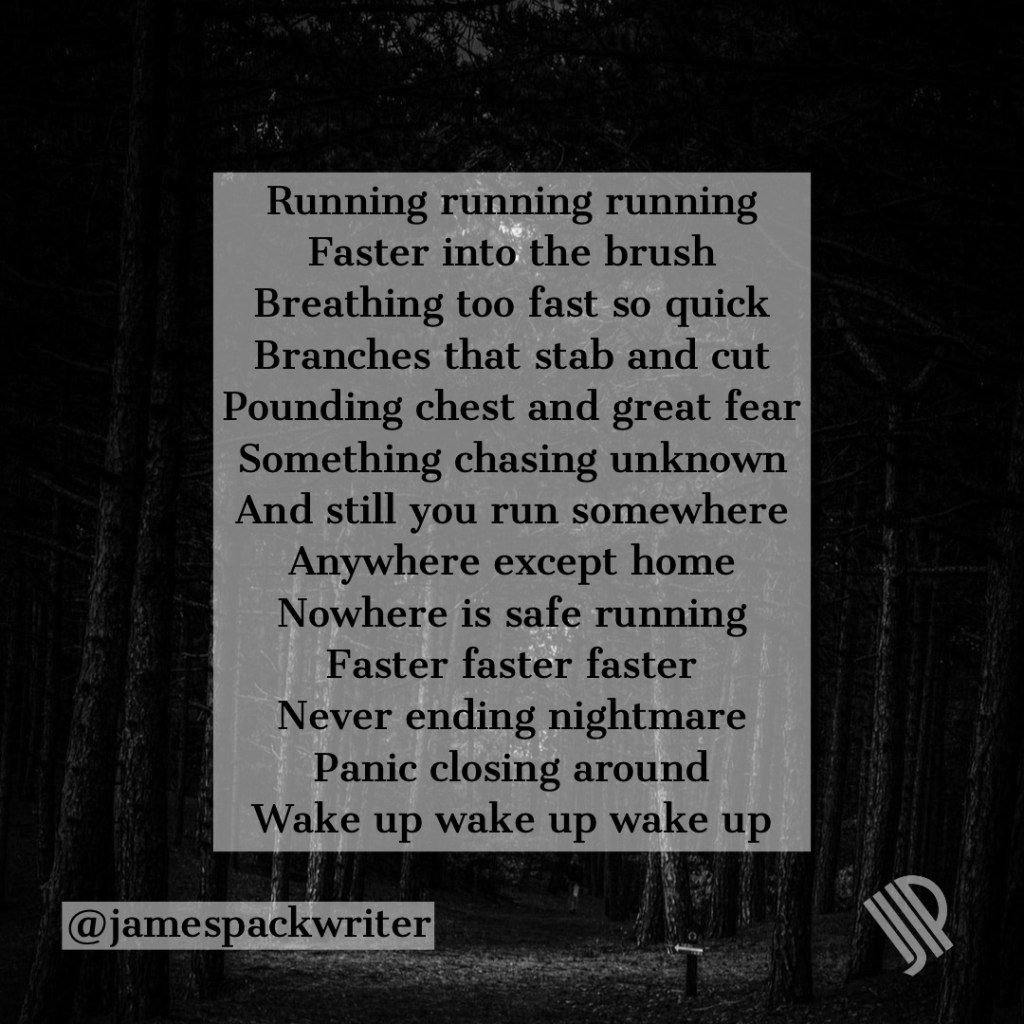
The first poem featured is “Running Nightmare Wake Up” from the collection Cats, Coffee, Catharsis. The second poem featured is “Hungry” from the collection Pariah Bound: The Lonesome Poetry.